By Aaron Koszyk, Owner, Double A Power Washing · 8 min read
You scrub the driveway, the orange fades, and before the season is out it is back in the exact same spot. That is not a cleaning problem. That is a source problem, and until you find what is feeding iron into your concrete or siding, rust stain removal alone will not hold for long.
We have worked on properties all along the Michiana lakeshore, from Long Beach through New Buffalo and up into southwest Michigan, and the pattern is almost always the same. The stain is a symptom. The real problem is hiding above it, beside it, or underground beneath it. It is worth a few minutes to understand what you are actually dealing with before you call anyone to clean it.
Quick Answer: Rust stains on concrete and siding return because the iron source, typically a well, an irrigation head, or a corroding metal fixture, is never addressed; professional rust stain removal with the right acid based chemistry clears the stain, but only fixing or filtering the source prevents it from coming back.
Key Takeaways
- Rust stains on concrete and siding are caused by dissolved iron, almost always from a well, an irrigation system, or a corroding metal fixture above the stain.
- Pressure washing alone does not remove rust stains. The iron bonds with the surface and requires a specialized acid based chemistry to break that bond and lift the stain.
- Cleaning without fixing the source guarantees the stain returns.
- Lake homes near Long Beach and the Lake Michigan shoreline are especially prone to well water carrying dissolved iron that runs through irrigation heads and deposits iron on every surface it touches.
- A professional assessment identifies the source so you are not paying for the same cleaning job over and over.
In This Article
Where the Iron Is Coming From
Iron does not appear on your concrete out of nowhere. There are three sources we see repeatedly on properties near Long Beach and across the Michiana lakeshore.
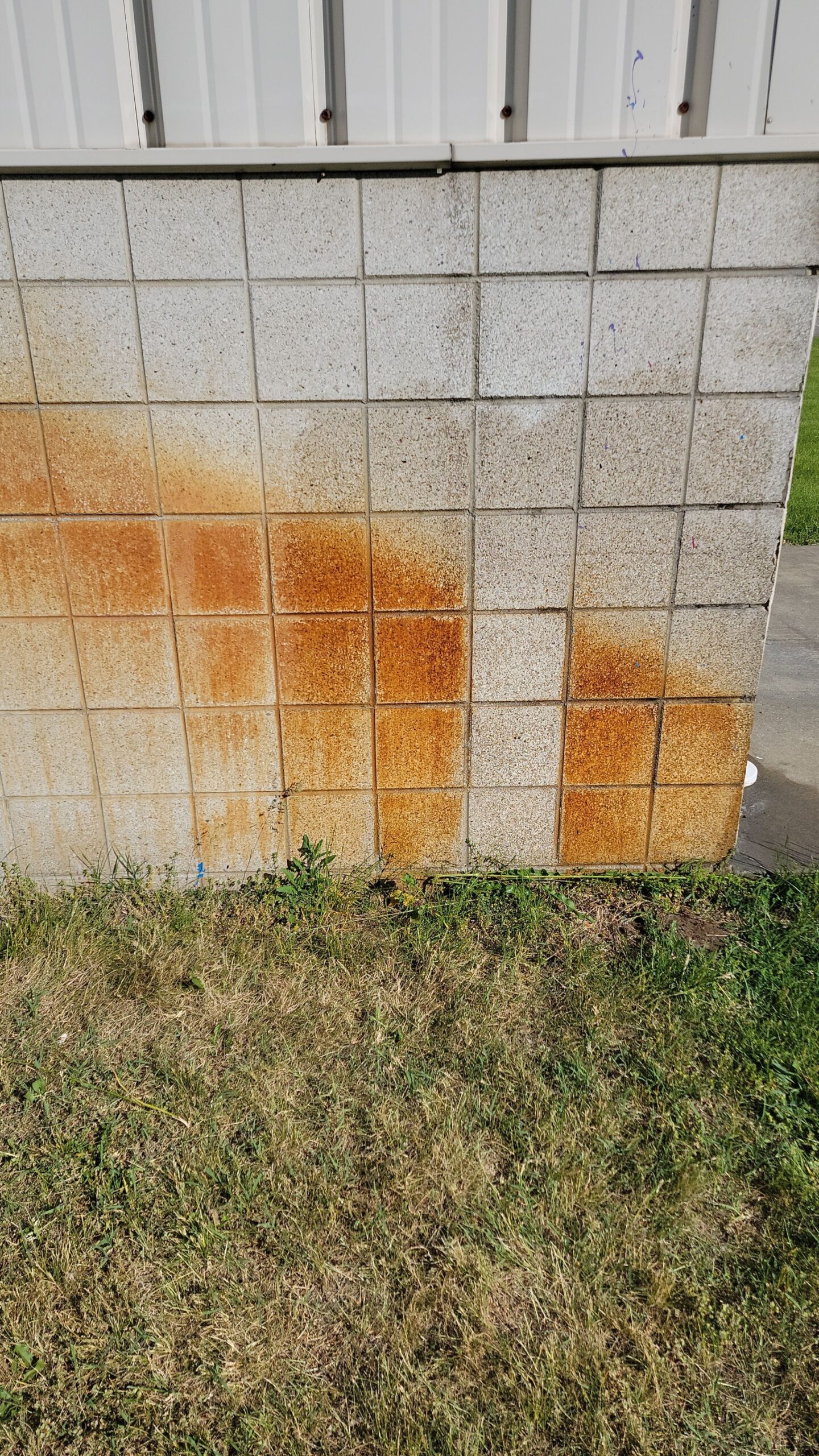
The most common is well water. Many lake home properties on the Indiana shoreline sit on private wells, and groundwater in this region naturally carries dissolved iron. When that water runs through an irrigation system and sprays across a concrete driveway, a paver patio, or the lower siding on your home, it deposits a thin film of iron with every cycle. Over time, that film oxidizes in contact with air and turns orange. The stain pattern often follows the spray arc of a specific head, and once you see it, the source becomes obvious.
The second source is a corroding metal fixture sitting above the stain. A rusting steel pipe, a cast iron downspout bracket, an aging metal post anchor, or a deteriorating iron railing can slowly bleed rust down the surface beneath it every time it rains. These stains tend to be concentrated in a narrow streak directly below the fixture rather than spread across a wide area.
The third source is rebar or embedded metal below the concrete surface. If the steel reinforcement inside a slab begins to corrode, the iron migrates up through hairline cracks and blooms on the surface. These stains come back fast after cleaning because the source is locked inside the slab itself.
Why Standard Pressure Washing Does Not Work on Rust
Every season we get calls from lake home owners who rented a pressure washer to knock out an orange stain. The stain is still there. High pressure moves surface dirt and organic growth just fine.
It does not remove rust.
Iron oxide bonds chemically with concrete and with the mineral compounds in brick, stucco, and siding. Pressure does not break that bond. All it does is strip away loose material around the stain and leave the iron embedded in the pores of the surface. In some cases, aggressive pressure actually drives the iron deeper, making the next cleaning harder.
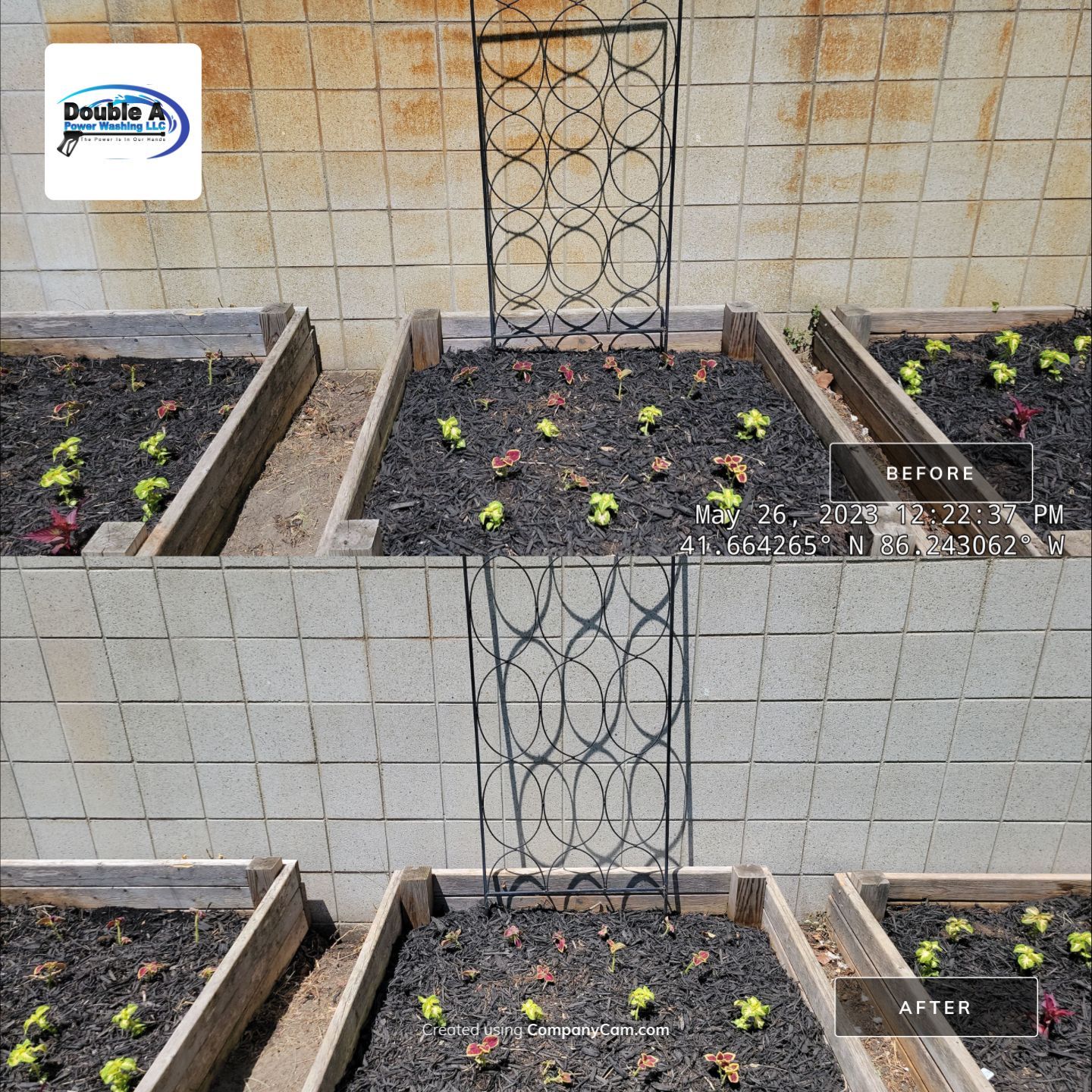
What actually works is an acid based chemistry specifically formulated to chelate iron, meaning it grabs the iron molecules and releases them from the surface so they can be rinsed away. We apply it at the right concentration for the surface type, let it dwell long enough to do the work, and then rinse thoroughly. On concrete, the difference is visible soon after application. On siding, we use a lower concentration and shorter dwell time because the finish is more sensitive than raw concrete.
Too weak a mix and the stain only partially lifts. Too strong a mix on the wrong surface and you risk etching or bleaching. That is why we assess the surface and the stain before we mix anything.
Pro Tip: Before you schedule a rust stain cleaning, walk your irrigation zones manually and watch where each head is spraying. If any head is hitting concrete or siding, that is almost certainly your source and redirecting it costs far less than repeated cleanings.
The Source Problem: Why Your Rust Stain Keeps Coming Back
Here is the conversation we have with lake home owners more than any other. The cleaning worked. The surface looked great. Then the orange came back.
Nothing went wrong with the cleaning. The stain returned because the source was never addressed. If well water with dissolved iron is still spraying the same driveway section on a regular irrigation cycle, that section is going to rerust. If the corroding downspout bracket is still sitting in place, it is still feeding iron down the fascia and into the concrete below every time it rains.
We will tell you what we find when we are on site. If an irrigation head is clearly the culprit, pointing it out is part of doing the job honestly. Redirecting that head, installing a filter on the irrigation line, or switching affected zones to a city water source where available are all things your irrigation contractor can address. If a corroding fixture is the source, replacing or sealing it before we clean means the cleaning lasts.
We are not irrigation contractors or plumbers. But we know what we are looking at when we see these patterns, and we would rather you spend money fixing the source than pay us to clean the same stain twice a season.
Ready for a free, no-pressure estimate?
Call or text one of our exterior cleaning specialists, or request your quote online anytime.
Call: 574-221-8400Text: 574-221-8400
Calls & texts answered Mon–Sun, 7AM–7PM
What Surfaces We Remove Rust Stains From
Rust stain removal on lake home properties is rarely just a driveway job. Well water carrying dissolved iron does not respect surface types, and one zone of sprinkler heads can stain a driveway, a sidewalk, a paver patio, and the lower portion of siding all in the same season.
We remove rust stains from concrete driveways, sidewalks, and patios. We remove them from brick, pavers, stucco, and vinyl siding. Each surface requires a different approach because the porosity and finish vary. Concrete and brick are porous and absorb iron deeply, so they typically need a longer dwell time. Vinyl siding is not porous but can be stained on the surface by iron deposits, and the chemistry and concentration we use there is calibrated carefully to avoid any effect on the finish.
One thing we will always say upfront: deeply embedded rust in older, porous concrete or brick that has gone untreated for multiple seasons may not come completely clean in a single application. Significant improvement is almost always achievable. Complete removal depends on how long the iron has been bonding with the surface and how deeply it has penetrated. We will tell you that before we start, not after.
DIY vs. Hiring a Pro
| Factor | DIY / Rental | Double A Power Washing |
|---|---|---|
| What removes rust | Pressure washing or store cleaners that rarely contain the right chemistry | Acid based chelating chemistry calibrated for the specific surface and stain depth |
| Surface safety | Wrong concentration risks etching concrete or bleaching siding finish | Mix strength matched to surface type before any chemical touches the job |
| Source identification | Stain treated without identifying what is feeding the iron | Assessment on site identifies irrigation, fixture, or rebar as the likely source |
| Result longevity | Stain returns if the source is still active | Cleaning lasts when paired with source correction; we tell you what needs fixing |
| Multiple surfaces | Same approach applied to every surface regardless of porosity | Different dwell times and concentrations for concrete, brick, pavers, and siding |
Pro Tip: If you have a well and an irrigation system, ask your water treatment company to test your iron levels. Whole house or point of irrigation iron filters exist specifically for this problem and can protect every surface on your property permanently.
What to Expect When You Call Us for a Rust Stain Job Near Long Beach
We serve properties all along the Lake Michigan shoreline in Indiana and into southwest Michigan, including Long Beach, New Buffalo, Grand Beach, Michiana, and the surrounding area. Rust stain removal work is not something we quote sight unseen without at least a few photos, because the surface type, the extent of the staining, and the likely source all affect the job.
When you reach out, send us a photo of the stain and tell us what material the surface is made of. If you know or suspect an irrigation system is involved, mention that too. We will follow up with any questions and give you a clear picture of what is realistic before any work begins.
Our minimum job is $350, and rust stain removal pricing varies based on the square footage affected, the surface type, and how many areas need treatment. We do not quote a flat rate for rust work because two properties on the same street can be very different jobs. A free estimate is the right starting point, and we will be straight with you about what the cleaning can and cannot do.
Looking for more than rust stain removal? We also offer house washing, concrete cleaning, roof cleaning, and gutter cleaning throughout the Long Beach area.
Why Choose Double A Power Washing?
Double A Power Washing has been working on properties across the Michiana area since 2019. We are PWNA members, BBB A+ accredited, and fully licensed and insured. We do not show up with a uniform approach to rust work, because rust work does not work that way.
We look at the stain, we look at what is above and around it, and we tell you honestly what the cleaning will accomplish and what it will not before any chemistry goes down. Lake home owners along the Long Beach and Lake Michigan shoreline have come to us after battling the same stain for multiple seasons. The difference between a cleaning that lasts and one that does not is almost always whether the source gets identified. We make that part of every rust job we take.
What Our Customers Say
“Professional- fair prices – excellent work! I had my house and shed soft washed. They turned out so good! I also had my sidewalk and patio done. All I can say is WOW! I highly recommend.”
— Michele Graddy, Google Review
Frequently Asked Questions
What causes orange rust stains on my concrete, siding, or pool deck?
The orange color is iron oxide, the same chemistry as ordinary rust. It gets onto your surfaces when water carrying dissolved iron makes contact with them repeatedly. On lake home properties, the most common culprits are well water carrying dissolved iron running through an irrigation system, a corroding metal fixture sitting above the stain, or steel rebar inside the concrete that has begun to corrode and push iron up through cracks in the slab.
Can you guarantee complete rust stain removal?
We guarantee the right chemistry and process for your specific surface. In most cases, the improvement is significant and visible. But complete removal depends on how long the iron has been bonding with the surface and how deeply it has penetrated. Stains that have sat untreated through multiple seasons on porous concrete or brick may not lift entirely in one pass. We will be straight with you about what to expect before we start.
Is the rust removal chemical safe for my plants and pets?
We protect surrounding vegetation and rinse thoroughly after application. We ask that pets stay away from the work area during the job and until the surface is fully rinsed and dry. If you have sensitive plantings close to the stained area, let us know when you schedule and we will plan around them.
Will rust stains keep coming back if I do not fix the source?
Yes. If the iron source is still active after cleaning, the stain comes back. The cleaning removes what has already bonded to the surface. It does not stop new iron from being deposited. Addressing the source is the only thing that makes the result last.
Do you remove rust stains from brick, pavers, and stucco as well as concrete?
Yes. We work on concrete, brick, pavers, stucco, and vinyl siding. Each surface requires a different approach because porosity and finish vary. We assess the material before mixing anything and adjust concentration and dwell time accordingly.
If you are a lake home owner near Long Beach, New Buffalo, Grand Beach, or anywhere along the Michiana shoreline and those orange stains have been coming back season after season, give us a call. We will look at what is actually causing them, clean what the chemistry can clean, and tell you straight what needs to change to keep them from coming back.
That is the only approach that actually works.
Call us at (574) 221-8400 or visit doubleapowerwashing.com to request a free estimate. We serve Long Beach, New Buffalo, Grand Beach, Michiana, and communities across northwest Indiana and southwest Michigan.
Keep Reading
Composite decks on the southwest Michigan lakeshore collect algae, tannin stains, and green film all summer long. A late August soft wash cl…
Water with high iron content in South Bend and Mishawaka leaves orange rust streaks that pressure alone cannot touch. Here is why the stain …
Most lake home owners along the southwest Michigan shoreline only call for exterior cleaning when something already looks bad enough to emba…