By Aaron Koszyk, Owner, Double A Power Washing · 9 min read
That green fuzz creeping across your north facing slope is not sitting still. It is eating your shingles, and October is the last month you can stop it before winter does the rest of the work for it.
Roof cleaning in Osceola IN turns up the same problem on street after street: north facing slopes that collect moisture rising from the St. Joseph River valley all season long. Osceola sits just west of Elkhart along US-20, and its established ranch homes and newer builds share this quiet issue. The moisture lingers. It feeds growth that does not announce itself loudly until the damage is already underway. By the time the streaks are obvious from the street, the biology causing them has been at work for months.
This post explains exactly what is growing on your roof, what it is doing to your shingles, and why the method of cleaning matters as much as the timing. If you are thinking about reaching for a pressure washer, read the third section first.
Quick Answer: Black streaks on your roof are a living algae called Gloeocapsa magma, and moss physically lifts shingles. Both shorten roof life. Soft washing with low pressure and surfactant chemistry kills them at the root without damaging shingles, and results typically last two to four years.
Key Takeaways
- Black streaks are Gloeocapsa magma algae, a living organism that feeds on your shingle limestone filler and holds moisture against the surface
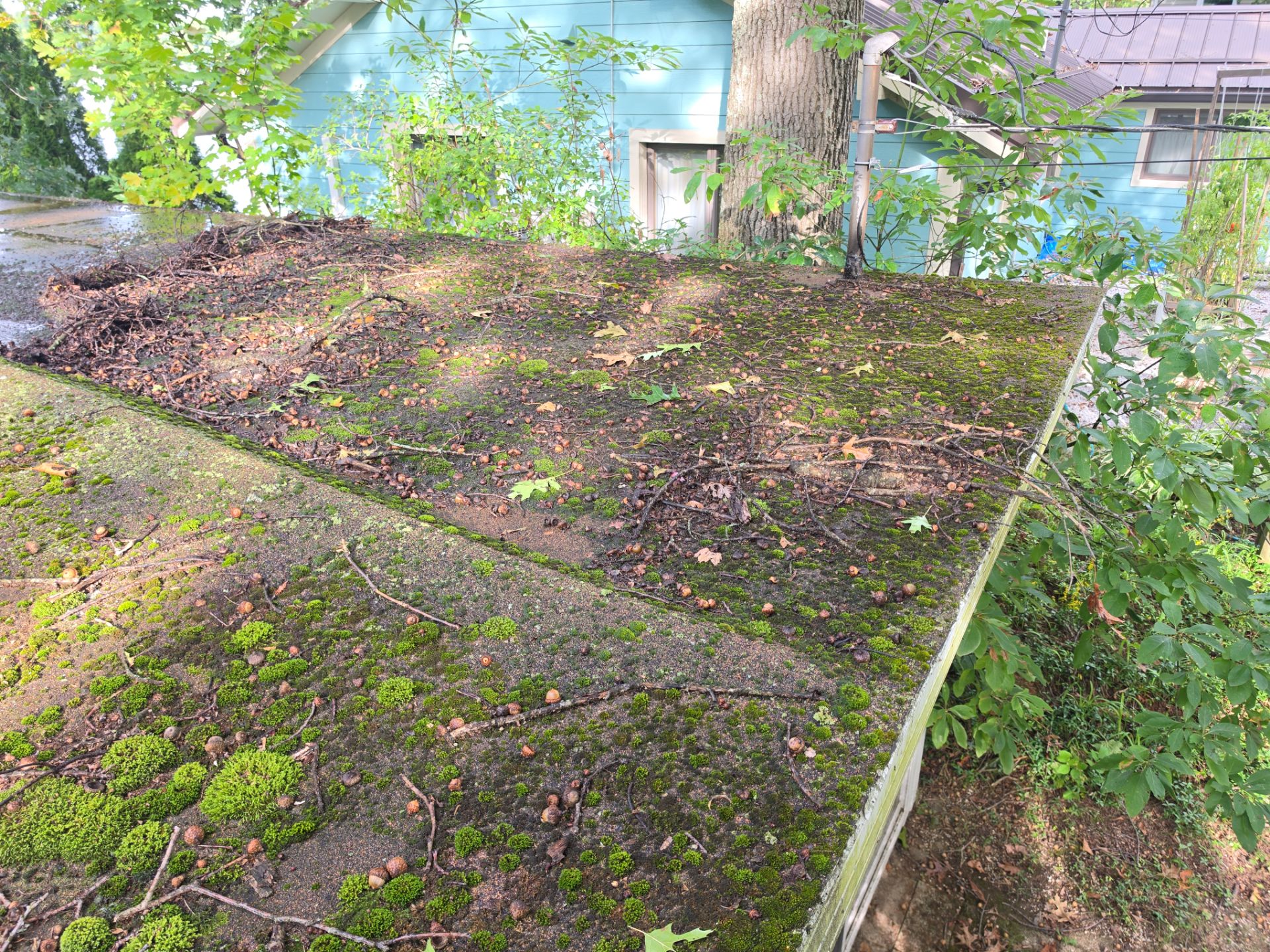
- Moss is a separate and more aggressive problem: it physically wedges under shingle edges and lifts them, allowing water in
- Pressure washing blasts off protective granules and can cut years off shingle lifespan
- Soft washing uses low pressure and biodegradable surfactant chemistry to kill algae and moss at the root, the same approach shingle manufacturers recommend
- Roof cleaning results typically last two to four years, depending on tree canopy and shade exposure
In This Article
What Those Black Streaks Actually Are
They are not soot, not pollution, and not simple dirt. The dark streaks running down your shingles are a cyanobacterium called Gloeocapsa magma, a microscopic organism that travels on wind and takes hold wherever moisture sits long enough to support it.
Gloeocapsa magma produces a dark pigmented sheath around itself as a defense against ultraviolet light. That sheath is what you see from the street: the characteristic dark gray or black streaking, usually running vertically where water flows during rain. The organism feeds on the limestone filler manufacturers use to give asphalt shingles their weight and durability. As it eats, it weakens the shingle matrix from the surface inward.
The secondary damage is moisture retention. The algae layer holds water against the shingle surface longer than bare asphalt would, accelerating granule loss and creating the conditions that moss and lichen need to take hold next. Left alone, the progression is predictable: algae now, moss within a season or two, lichen not long after. Each stage is harder to remove than the last.
What Moss Does Differently and Why It Is the More Urgent Problem
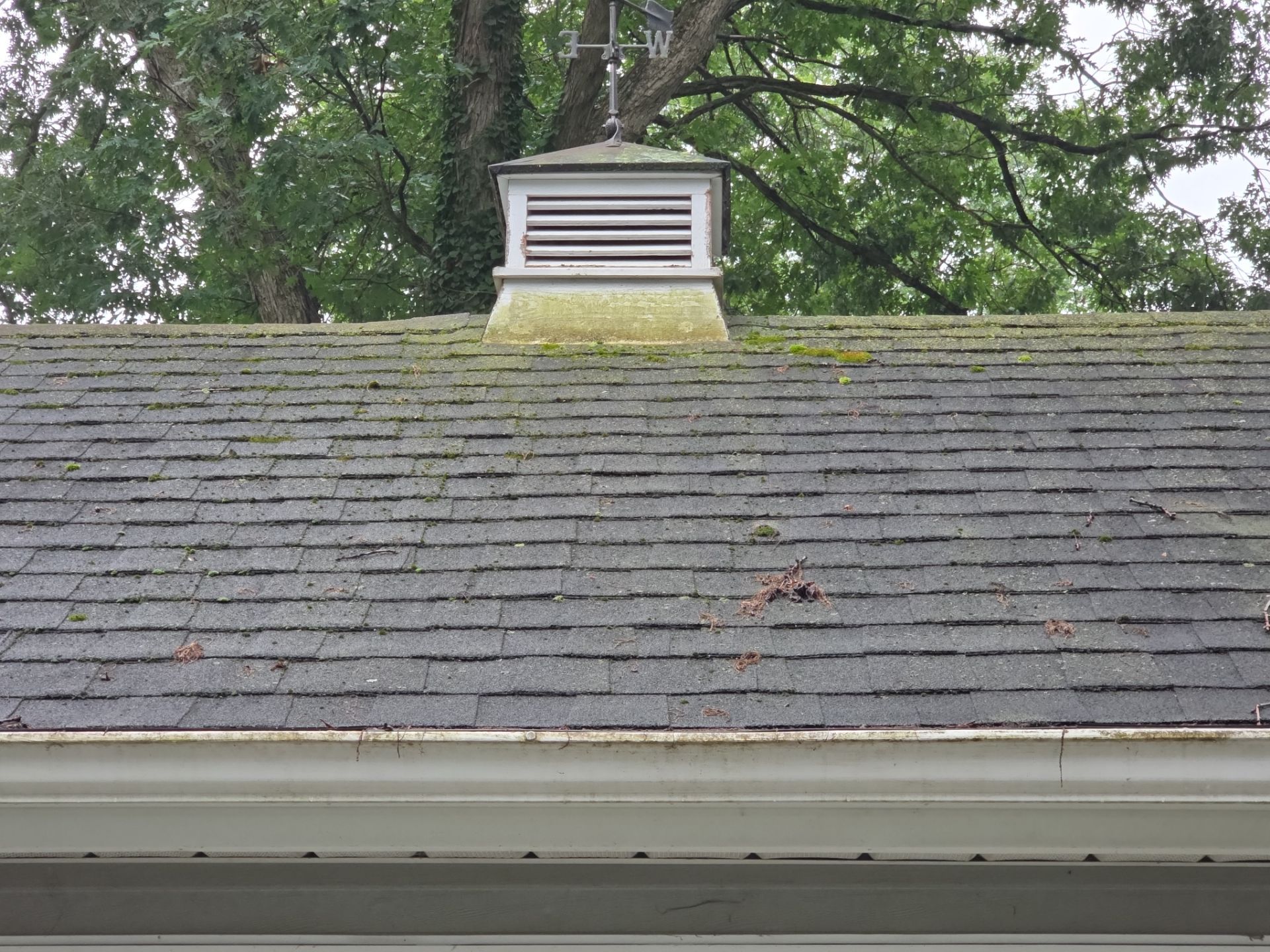
Algae stains and degrades from the surface. Moss does something structurally worse: it grows under shingle edges and physically lifts them.
Moss holds water like a sponge. A dense mat can stay wet for days after rain, pressing against your shingles and keeping the wood decking beneath in a nearly constant state of elevated moisture. In northern Indiana, that detail matters a great deal in fall and winter. Water trapped under lifted shingles freezes, expands, and pries the shingle tabs further from the decking below. By late October in Osceola, that freeze and thaw cycle starts in earnest.
A roof with active moss growth going into November is not a cosmetic problem. It is a water intrusion risk that compounds with every overnight freeze. The cost difference between cleaning a roof before winter and replacing damaged decking and shingles after is not close.
Pro Tip: October is the last practical month for roof cleaning in northern Indiana before overnight temps below 40 degrees make surfactant chemistry ineffective. If your roof has visible growth, schedule before the end of the month.
Can I Use a Pressure Washer to Remove Moss From My Roof?
The instinct makes sense: you can see the problem, and pressure washing removes what you can see. The trouble is what it removes along with the growth.
Asphalt shingles are covered in mineral granules, the rough, gritty surface you can feel underhand. Those granules are not decorative. They protect the asphalt layer underneath from UV degradation, reflect heat, and contribute directly to the fire rating of your roof. Manufacturers rate shingles with the expectation that the granule layer stays intact for the life of the product.
A pressure washer at typical operating pressure strips granules with every pass. You can see them washing away in the runoff, small flecks of mineral collecting in your gutters. Even a single aggressive pass shortens effective shingle life. Multiple passes, or any attempt to blast heavy moss, accelerate that loss dramatically.
Beyond granule loss, the force of the water can breach the overlap between shingle courses, driving water horizontally into places it was never meant to go. The roof looks clean afterward. The damage is real.
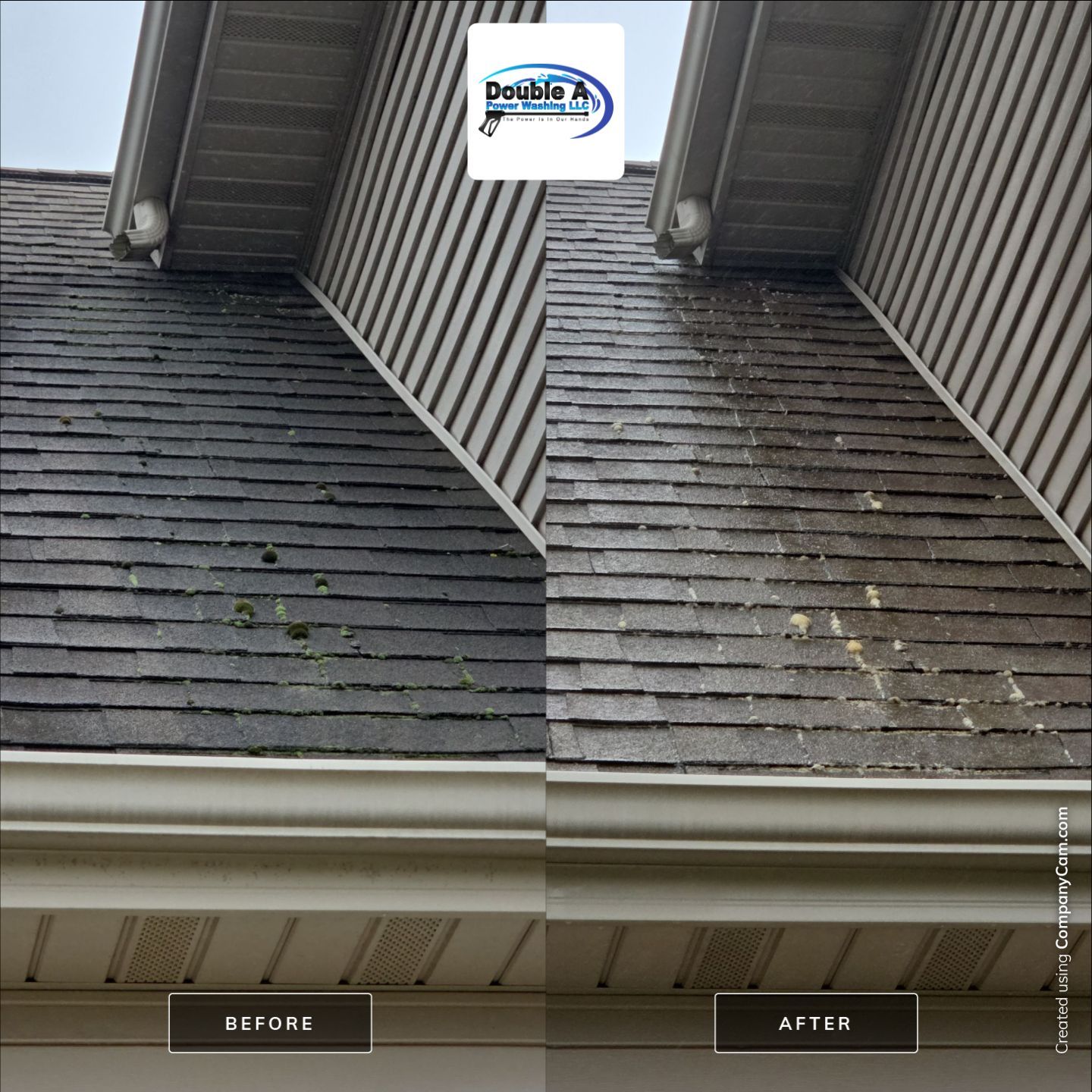
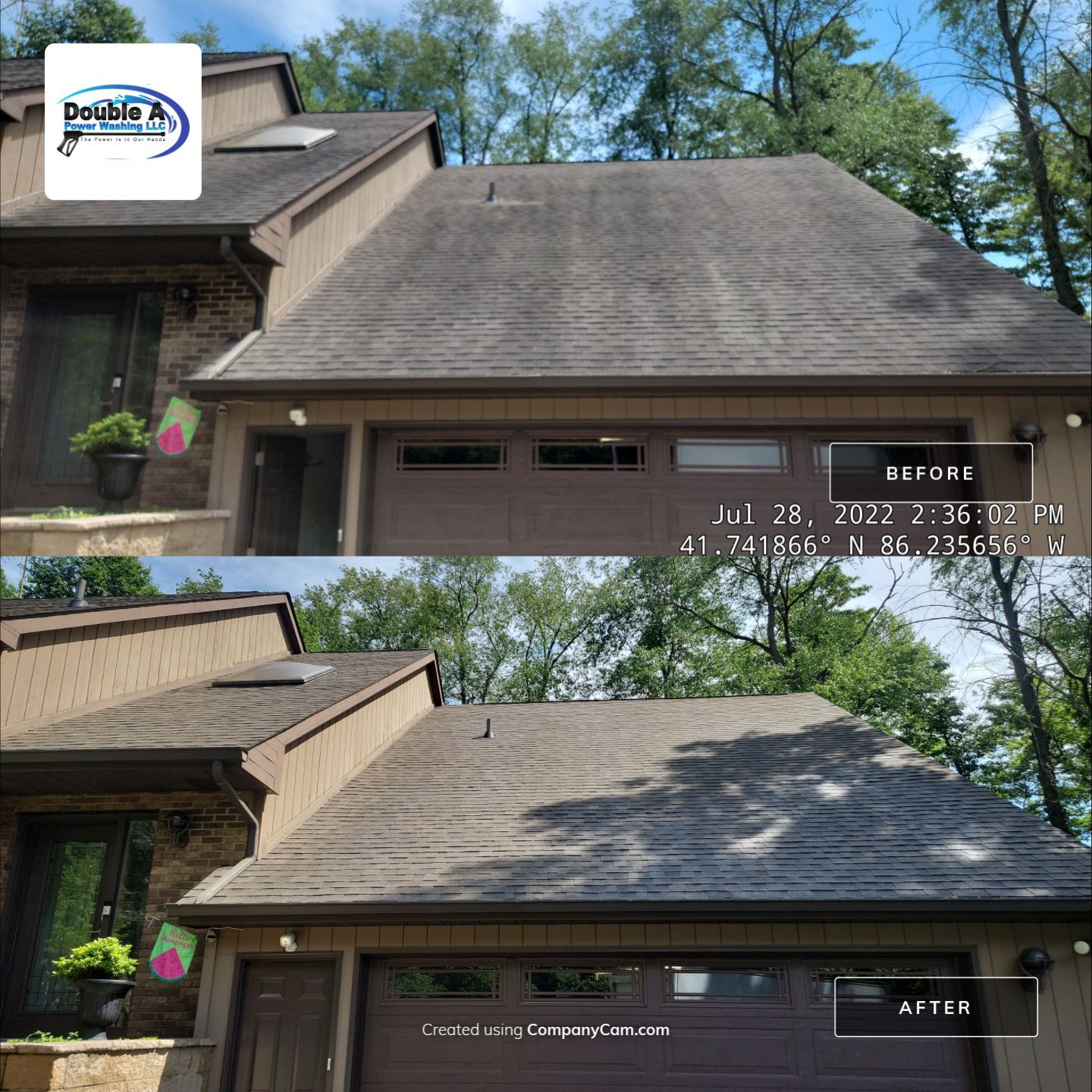
See the Difference
Ready for a free, no-pressure estimate?
Call or text one of our exterior cleaning specialists, or request your quote online anytime.
Call: 574-221-8400Text: 574-221-8400
Calls & texts answered Mon–Sun, 7AM–7PM
How Soft Wash Roof Cleaning Near Me Actually Works
Soft washing applies a low pressure rinse, closer to a garden hose than a pressure washer, paired with a surfactant cleaning formula that kills biological growth at the cellular level rather than blasting it away physically.
The active chemistry in a roof soft wash is a diluted sodium hypochlorite mix combined with a surfactant. The surfactant helps the formula cling to the shingle surface and penetrate the algae and moss rather than sheeting off immediately. The sodium hypochlorite breaks down the cell walls of Gloeocapsa magma and kills moss and lichen at the root structure, not just at the visible surface.
This is why the method matters. Pressure washing removes what is visible while leaving root systems and spores behind. Soft washing kills the organism. The visible growth rinses away or weathers off over the following weeks. It does not come back from the same root structure because that structure has been eliminated.
Our crew applies the formula from a safe working position, allows appropriate dwell time for the chemistry to do its work, and rinses at low pressure. The shingles are never subjected to force that could displace granules or breach the overlap between courses.
What We Do to Protect Your Plants
Before any chemistry goes on the roof, we soak all surrounding landscaping with clean water. A plant already saturated with clean water cannot take up much of anything else. We rinse again after the job is done. In our years of roof cleaning across Michiana, we have not had plant damage from the process when this step is done correctly.
DIY vs. Hiring a Pro
| Factor | DIY / Rental | Double A Power Washing |
|---|---|---|
| Pressure | Typically 1,500 to 3,000 PSI from a rented machine | Low pressure, close to garden hose output. No granule risk. |
| Granule loss | Visible granule loss in runoff; shortens shingle life | No mechanical force on granules; shingle surface stays intact |
| Root elimination | Removes visible growth but leaves root systems and spores | Surfactant chemistry kills algae and moss at the cellular root |
| Warranty impact | High pressure washing voids many shingle manufacturer warranties | Soft washing is the method manufacturers specify as acceptable |
| Result duration | Regrowth typically returns within one season from surviving spores | Results last two to four years with root kill chemistry |
| Plant safety | Runoff from cleaning chemistry can burn landscaping if plants are not soaked first | Plants soaked with clean water before and rinsed after; established crew protocol |
Pro Tip: Gutters full of granule sediment are an early sign that your shingles are already degrading. If you are cleaning your roof, have your gutters checked at the same time. The two jobs pair naturally.
Does Soft Washing Void Your Shingle Warranty?
No. For many shingle products, the opposite is closer to true.
Major shingle manufacturers including GAF and Owens Corning specify in their maintenance guidelines that low pressure washing with appropriate cleaning chemistry is an acceptable and recommended cleaning method. Pressure washing, by contrast, is explicitly prohibited in the warranty documentation of many shingle products because of the granule loss it causes.
If your roof is still under a manufacturer warranty and you are concerned, the guidance to look for is simple: low pressure, appropriate chemistry, no mechanical scrubbing. That is soft washing. What voids warranties is high pressure application, abrasive cleaning, and anything that physically removes granules. We clean roofs the way the people who made your shingles say to clean them.
How Long Does Roof Algae Removal Last in the South Bend and Elkhart IN Area?
Most roofs in the Osceola and Elkhart County area stay clean for two to four years after a soft wash. Two factors drive that range more than anything else: how much tree canopy overhangs the roof, and how much shade the slope gets through the day.
North facing slopes in Osceola, with limited direct sun and the moisture influence of the St. Joseph River valley nearby, tend toward the lower end of that range. Heavy oak or maple canopy overhead accelerates regrowth compared to a roof with full southern exposure. That is not a failure of the cleaning process. It is the reality of the growing environment.
One thing homeowners sometimes expect and do not see: the roof does not look dramatically different the same day. Soft washing kills the growth, but weathering carries the dead material away over the following weeks. Clean in October, get a few good rain events before snow, and you will notice the color improving through November. The full result is visible by spring.
We are also honest about walking on roofs. For most residential slopes in Osceola, our crew can clean from ladders and extended reach equipment without walking the surface. We assess each roof individually. If walking is required, we discuss it with the homeowner first.
Looking for more than roof cleaning? We also offer house washing, concrete cleaning, roof cleaning, and gutter cleaning throughout the Osceola area.
Why Choose Double A Power Washing?
Double A Power Washing has been cleaning roofs across Michiana since 2019. We are PWNA members, BBB A+ accredited, fully licensed and insured, and we carry a 5-star Google rating across more than 130 reviews. We run a dedicated soft wash system, a 24v Zeus with mixing valves, on our residential rig specifically because roof chemistry requires precise dilution, not whatever comes out of a standard pressure washer.
When we quote a roof cleaning in Osceola or anywhere in the St. Joseph County and Elkhart County area, we look at the actual slope, the canopy situation, and what is growing before we give a number. There is no flat rate that fits every roof, and we do not pretend there is. Our minimum job is $350, and we direct every customer to a free estimate before anything is scheduled. Call us, describe what you are seeing, and we will tell you straight what it will take.
What Our Customers Say
“On time truly showed interest for our needs. Double checked the house before starting job very quick I was impressed with the service.”
— Philip Watson, Google Review
Frequently Asked Questions
What are the black streaks on my roof?
They are Gloeocapsa magma, a cyanobacterium that feeds on the limestone filler in asphalt shingles. It produces a dark protective pigment that causes the streaking you see from the street. Beyond the appearance, it holds moisture against the shingle surface and accelerates granule loss over time.
Can I use a pressure washer to remove moss from my roof?
You can blast the visible moss away, but pressure washing at typical operating levels strips protective mineral granules from your shingles in the process. Many shingle manufacturers void warranties for that kind of damage. Beyond granule loss, pressure washing leaves root structures and spores behind, so the moss returns faster than it would after a proper chemical kill. Soft washing is the right method.
Does soft washing void my shingle warranty?
No. Soft washing with low pressure and appropriate cleaning chemistry is the method recommended or approved by major shingle manufacturers including GAF and Owens Corning. What voids warranties is high pressure washing, abrasive scrubbing, and mechanical granule removal. None of those are part of soft washing.
How long does roof cleaning last?
For most roofs in the Osceola and South Bend area, soft wash results last two to four years. Roofs with heavy tree canopy or north facing slopes with limited sun will see regrowth return toward the shorter end of that window. Roofs with good southern exposure and minimal shade typically hold clean closer to four years.
Will your cleaning chemicals harm my landscaping or pets?
We soak all landscaping with clean water before applying any roof chemistry, and we rinse again after the job. A plant already saturated with clean water takes up very little of anything else. Pets should be kept inside or away from the work area during the job and for about an hour after rinsing is complete.
If you are looking at dark streaks or green growth on your Osceola roof right now, this month is the window. Once overnight temperatures drop consistently below 40 degrees, surfactant chemistry stops working effectively and soft washing has to wait until spring. By then, a full Indiana winter of freeze and thaw cycles will have had months to work on whatever is already under those shingles.
Do not hand winter that kind of head start. We serve Osceola, South Bend, Elkhart, Mishawaka, and the surrounding Michiana area. Estimates are free and scheduling is straightforward. Call us at (574) 221-8400 or visit doubleapowerwashing.com to describe your roof and get a straight answer on cost and timing.
Keep Reading
Those dark streaks creeping down your lakeshore roof are not dirt. They are a living organism feeding on your shingles. Here is what is happ…
Those dark stripes running down your shingles aren’t age or grime, they’re a cyanobacteria called Gloeocapsa magma, and pressure washing onl…
Those black and grey streaks on your southwest Michigan lake home roof are not weather staining. They are a living organism eating your shin…