
By Aaron Koszyk — Owner, Double A Power Washing LLC · 10 min read
That orange streak on your driveway is not dirt, and no amount of scrubbing is going to move it. Rust stains are one of the most stubborn problems we see across South Bend, Mishawaka, and Granger, and almost every time we look at one, the issue is chemistry, not cleaning pressure. Once iron bonds into the pores of concrete or settles into the texture of vinyl siding, it is locked in place until the right product breaks that bond at the molecular level.
If your home needs this kind of cleaning, see our South Bend power washing page for services and pricing.
We get calls about this every season, especially from homeowners on well water in St. Joseph County and from neighborhoods served by older water mains. The iron content in a lot of Michiana water runs genuinely high. Run a sprinkler system all summer and by September the concrete edges and the lower panels of your siding will tell you. This post breaks down what is happening beneath the surface, what makes it worse year over year, and what our crew does to clear it without harming what is underneath.
Quick Answer: Rust stains on concrete and vinyl siding are chemically bonded iron deposits that require an oxalic or citric acid rust remover to break the bond. Pressure washing alone will not remove them.
Key Takeaways
- Rust stains are chemically bonded iron deposits. Pressure alone cannot remove them.
- South Bend and Michiana well and city water carries elevated iron that feeds repeat staining from sprinkler systems.
- Metal furniture, fertilizers with iron content, and rebar bleed from below the surface are three other common culprits.
- The right chemistry (oxalic or citric acid based) breaks the iron bond without etching concrete or streaking siding.
- Hardware store acids and wire brushing can permanently damage concrete and should be avoided.
In This Article
What Is Actually Causing the Orange Stain
Rust stains are iron oxide deposits. When water carrying dissolved iron hits concrete and evaporates, the iron gets left behind. Exposed to air, that iron oxidizes, the same process that turns a nail red in the rain. The result is that orange and brown streak that looks like it was painted on.
We clean driveways every week. Our driveway pressure washing in Mishawaka and South Bend page covers what to expect and pricing.
In South Bend and the surrounding area, there are four main sources we run into on nearly every rust stain job.
Sprinkler Systems Hitting Concrete or Siding
This is the most common one. If your sprinkler heads are running on well water or older municipal supply with elevated iron content, every watering cycle deposits a small amount of iron on whatever surface the spray hits. Over a full summer that adds up fast, especially along driveway edges and the bottom two feet of a house. The worst staining is usually fanned out directly in front of a sprinkler head.
Iron in Well Water and Older City Supply Lines
A significant portion of properties in St. Joseph County draw from wells, and iron levels in the local aquifer run high enough that you can sometimes smell it in the tap water. Even homes on city water in South Bend can see iron staining from aging distribution pipes. The iron is dissolved and invisible until it dries on a hard surface.
Metal Furniture, Planters, and Decorative Items
Cast iron furniture on a concrete patio all summer will leave a rust ring. The same goes for metal planters, steel edging, old grills, and any metal object that holds moisture against concrete. Rain and morning dew are enough to start the process.
Fertilizer With Iron Content
Some lawn fertilizers contain iron as a micronutrient. When a spreader passes over a driveway or runoff washes across concrete, it leaves iron behind. A single spring fertilizing cycle can produce noticeable staining on a light concrete driveway by midsummer.
Why Pressure Washing Does Not Remove Rust
This surprises a lot of homeowners. They rent a pressure washer, blast the driveway, and the orange stain is still there. It may look lighter while the concrete is wet, but once it dries it is right back. Pressure washing removes loose contamination: dirt, grime, mildew, organic material sitting on top of the concrete. Rust is not sitting on top.
Iron oxide penetrates into the microscopic pores of concrete and forms a chemical bond with the calcium silicate compounds in the material. Once that bond forms, water pressure cannot break it. You could put 5,000 PSI on a rust stain and move nothing but surface water. The iron stays put.
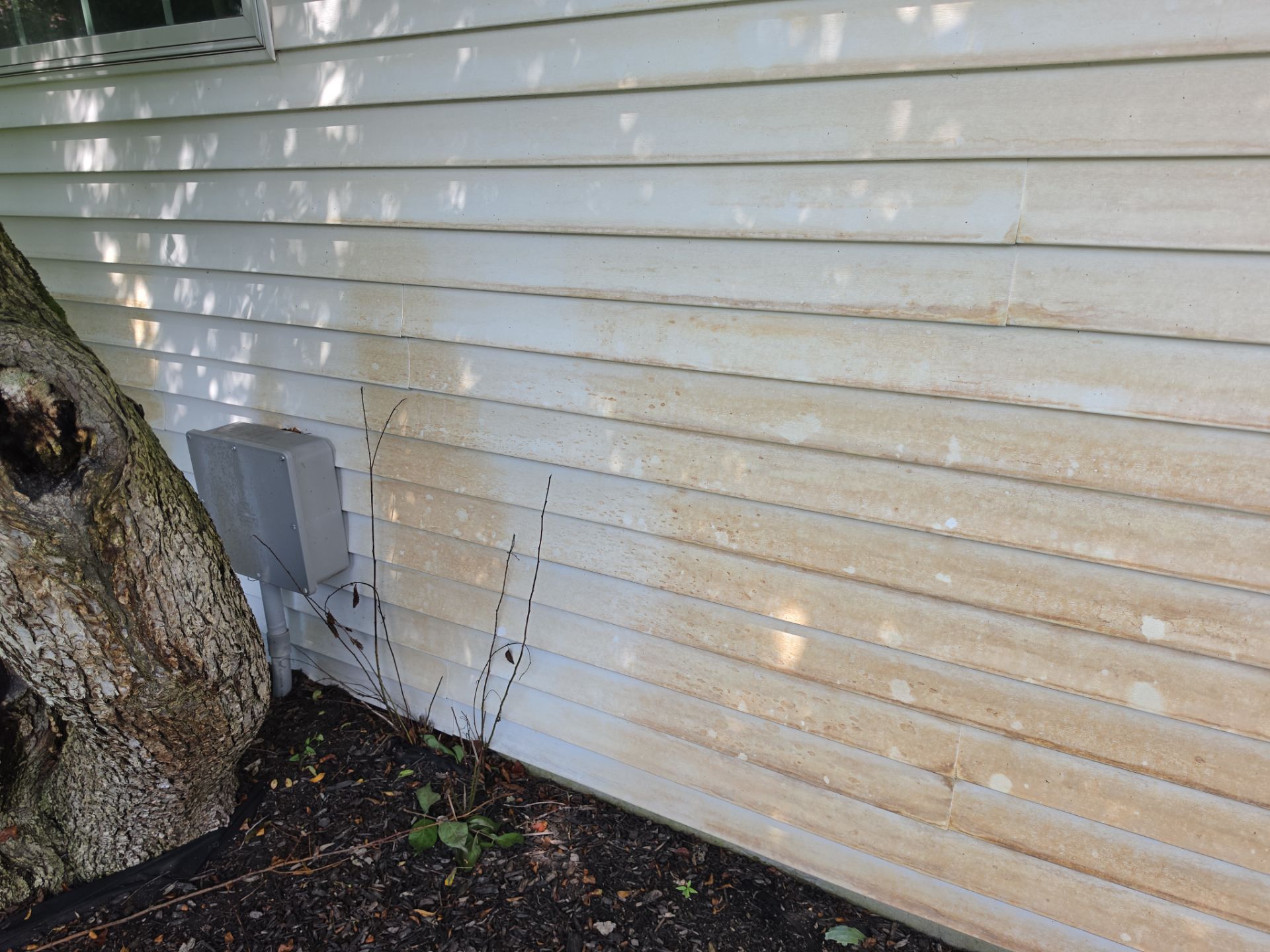
The same principle applies to vinyl siding. Vinyl is not as porous as concrete, but the surface texture of most siding profiles has fine grooves that trap iron particles and hold them against the panel where they oxidize. Pressure at the wrong angle just drives the particles deeper.
Removing rust requires chemistry, not force.
Pro Tip: If you can see a faint orange tint in your toilet bowl or white sink fixtures, your water has enough dissolved iron to stain your driveway. Address the water source and you cut down on how often the exterior needs treatment.
What Our Crew Actually Uses and Why
When we arrive at a rust stain job in South Bend or Mishawaka, we apply a targeted rust treatment chemistry before any water pressure gets involved. The active ingredient is typically oxalic acid or a citric acid based compound, sometimes a blend, depending on how deep and old the stain is.
The acid reacts with the iron oxide and converts it into an iron compound that dissolves in water. That compound can then be rinsed away. The stain does not scrub off. It is chemically converted and removed. That is a fundamentally different process from what pressure alone does.
On Concrete Driveways and Walkways
We wet the surface first, apply the rust treatment at the right concentration, and let it dwell for several minutes. We monitor the reaction and do not let the product dry on the surface. Then we rinse thoroughly to carry the converted iron off the concrete. For deep or very old stains we may do a second application. The surface is not etched, and the stain is gone rather than just faded.
On Vinyl Siding
Siding requires a gentler approach and a milder product concentration. We apply the rust treatment to the affected panels, work carefully along the siding grooves to reach the trapped iron, and rinse at low pressure. The soft wash approach protects the panel finish and does not force water behind the siding.
Realistic Timeframe
A typical rust stain job on a residential driveway or siding takes one to two hours. Heavily stained driveways or large commercial flatwork take longer. We give you an honest time estimate during the free quote because the stain pattern tells us how deep the iron has gone.
Ready for a free, no-pressure estimate?
Call or text one of our exterior cleaning specialists, or request your quote online anytime.
Call: 574-221-8400Text: 574-221-8400
Calls & texts answered Mon–Sun, 7AM–7PM
What You Should Not Do Before We Arrive
A few common DIY attempts at rust removal create problems that are harder to fix than the original stain.
Hardware Store Muriatic Acid
Muriatic acid (hydrochloric acid) is sold at home improvement stores, and some homeowners reach for it because it is an acid and the idea seems right. But muriatic acid is the wrong acid for rust. It does not have the specific affinity for iron oxide that oxalic or citric acid has. What it does very well is etch concrete, strip the surface layer, and leave behind a rougher surface that is actually more likely to stain again. It also generates fumes that require serious ventilation. We have cleaned driveways where someone tried muriatic acid first, and the concrete itself was damaged in addition to still having the rust stain.
Wire Brushing
Wire brushing a rust stain on concrete scratches the surface and spreads the iron particles into a wider area. You end up with a bigger, lighter stain on damaged concrete. On siding, a wire brush removes the protective finish.
Letting It Sit Through Another Season
Fresh iron deposits respond well to a single treatment. Stains that have been accumulating for two or three years bond progressively deeper into concrete pores. The sooner you address it, the cleaner the result.
DIY vs. Hiring a Pro
| Factor | DIY / Rental | Double A Power Washing |
|---|---|---|
| Removes surface dirt and grime | Yes, a pressure washer handles this well | Yes, covered as part of the full clean |
| Removes chemically bonded rust stains | No. Pressure alone cannot break the iron bond | Yes. Oxalic or citric acid treatment converts and lifts the iron |
| Risk of concrete etching | High if muriatic acid or excessive pressure is used | None. We use targeted rust treatment chemistry at calibrated concentrations |
| Risk of siding damage | Moderate to high with wire brushing or wrong acid | None. Low pressure soft wash approach protects the panel finish |
| Source identification | Often missed. Stain comes back in weeks | We walk through likely sources with you so the stain stays gone |
| Time to complete | Multiple attempts over a season, often inconclusive | One to two hours for most residential driveways or siding runs |
Pro Tip: Never let a rust treatment product dry on concrete or siding. It needs to stay wet and reactive until you rinse. That is why this job is harder in direct afternoon sun on a hot July day in South Bend than it looks.
Stopping the Stain From Coming Back
Rust removal solves what is on the surface right now. But if the iron source is still active, the stain will return. We always talk through the source with our customers, because a clean driveway that gets stained again by October is a frustrating outcome for everyone.
Adjust sprinkler heads so they are not spraying onto hardscaped surfaces. If you are on well water, a whole house iron filter makes a significant difference. Move metal furniture or add rubber feet so it is not sitting directly on concrete. Switch to a fertilizer without iron near your driveway or sidewalk.
For properties where the iron source cannot be fully eliminated, an annual treatment keeps the buildup manageable. We service properties across South Bend, Mishawaka, Granger, Elkhart, and Goshen on that kind of recurring basis.
Where We See This Most Often in South Bend and Michiana
Rust staining is not random. There are parts of the South Bend area where we see it more frequently, and the reasons almost always trace back to the water source.
Neighborhoods in the southern and eastern parts of St. Joseph County that draw from private wells tend to have the highest iron concentrations. If your well water leaves an orange ring in a white sink or toilet bowl, your driveway and siding are getting the same treatment. We do a significant amount of rust removal work in those areas every spring, right after irrigation systems get turned back on.
Older neighborhoods closer to downtown South Bend sometimes see iron staining from aging water service lines, particularly where galvanized pipe is still in the system.
Along the lakefront communities in Cass County, Michigan that we serve, including the Christiana Lake and Eagle Lake areas, well water is common and iron levels vary significantly. Lake access homes with irrigation systems drawing from the well are especially prone to siding staining on the lower panels.
Looking for more than rust stain removal? We also offer house washing, concrete cleaning, roof cleaning, and gutter cleaning throughout the South Bend area.
Why Choose Double A Power Washing?
Our crew has been removing rust stains from driveways and siding across South Bend and Michiana since 2019. We carry the right rust treatment chemistry on every truck, and we have done this enough times in St. Joseph County to know which water sources cause which stain patterns. We are PWNA certified, BBB A+ accredited, fully licensed and insured, and we have earned more than 138 Google reviews at a perfect 5.0 rating from real customers in the area.
One of those customers, Ann Haley, called us about iron staining from her water supply. After the job she said: “Aaron was great! Needed the concrete around my pool and the front walkway due to lots of iron in our water plus north side of my house power washed. He came right out and it looks great.” We treat every property like it is our own, and if anything does not look right when we are done, call us and we will make it right.
What Our Customers Say
“Aaron was great! Needed the concrete around my pool and the front walkway due to lots of iron in our water plus north side of my house power washed. He came right out and it looks great.”
— Ann Haley, Google Review
Frequently Asked Questions
What causes orange rust stains on my driveway or sidewalk?
Most rust stains on concrete driveways and sidewalks in South Bend and Mishawaka come from iron in the water supply hitting the surface and oxidizing as the water evaporates. Sprinkler systems are the most common source, especially on properties using well water with high iron content. Metal furniture, fertilizers with iron content, and iron bleed from rebar under the concrete surface are other frequent causes.
Will pressure washing remove rust stains from concrete?
No. Pressure washing removes loose surface contamination, but rust stains are chemically bonded iron oxide deposits that have penetrated into the pores of the concrete. Water pressure cannot break that bond. Removing rust requires applying a rust treatment chemistry, typically oxalic or citric acid based, that converts the iron compound into a form that dissolves in water and can then be rinsed away.
Can you remove rust stains from vinyl siding or brick?
Yes. We treat rust staining on vinyl siding with a diluted rust treatment product applied at low pressure so we do not damage the panel finish or force water behind the siding. Brick can also be treated, though older brick requires careful concentration control to avoid affecting the mortar. We assess the surface condition before any treatment.
Will the rust stain come back after treatment?
If the iron source is still active, yes. A sprinkler system still hitting the driveway or well water with high iron content will stain a clean surface again over time. We always discuss the likely source with you at the job so you know what to address. Adjusting sprinkler coverage, adding an iron filter, or moving metal furniture eliminates most repeat staining. For properties where the source cannot be fully removed, an annual maintenance cleaning keeps it manageable.
How do I get an estimate for rust stain removal in South Bend or Mishawaka?
Call us at (574) 221-8400 or visit doubleapowerwashing.com to request a free quote. We come out, look at the staining, assess how deep the iron has gone, and give you an honest price before any work starts. There is no charge for the estimate.
Orange rust streaks on your driveway or siding are not something you have to live with, and they are not something a pressure washer alone is going to fix. Our crew uses the right chemistry, applied correctly, to break the iron bond and clear the stain without damaging the concrete or siding underneath. We have done this across South Bend, Mishawaka, Granger, Elkhart, and the lake communities in southwest Michigan, and we know the water quality in this area well enough to give you a straight answer about what to expect.
Give us a call at (574) 221-8400 or get a free estimate at doubleapowerwashing.com. We will come out, look at what you have got, and tell you exactly what it takes to clear it.
Keep Reading
Every fall in South Bend, homeowners grab a pressure washer for one last driveway cleaning before the ground freezes. Some of them call us i…
Those dark stripes running down your shingles aren’t age or grime, they’re a cyanobacteria called Gloeocapsa magma, and pressure washing onl…
Those tiny black dots on your siding are artillery fungus spores shot up from wood mulch. Here is what they are, whether they are harmful, h…