By Aaron Koszyk — Owner, Double A Power Washing LLC · 8 min read
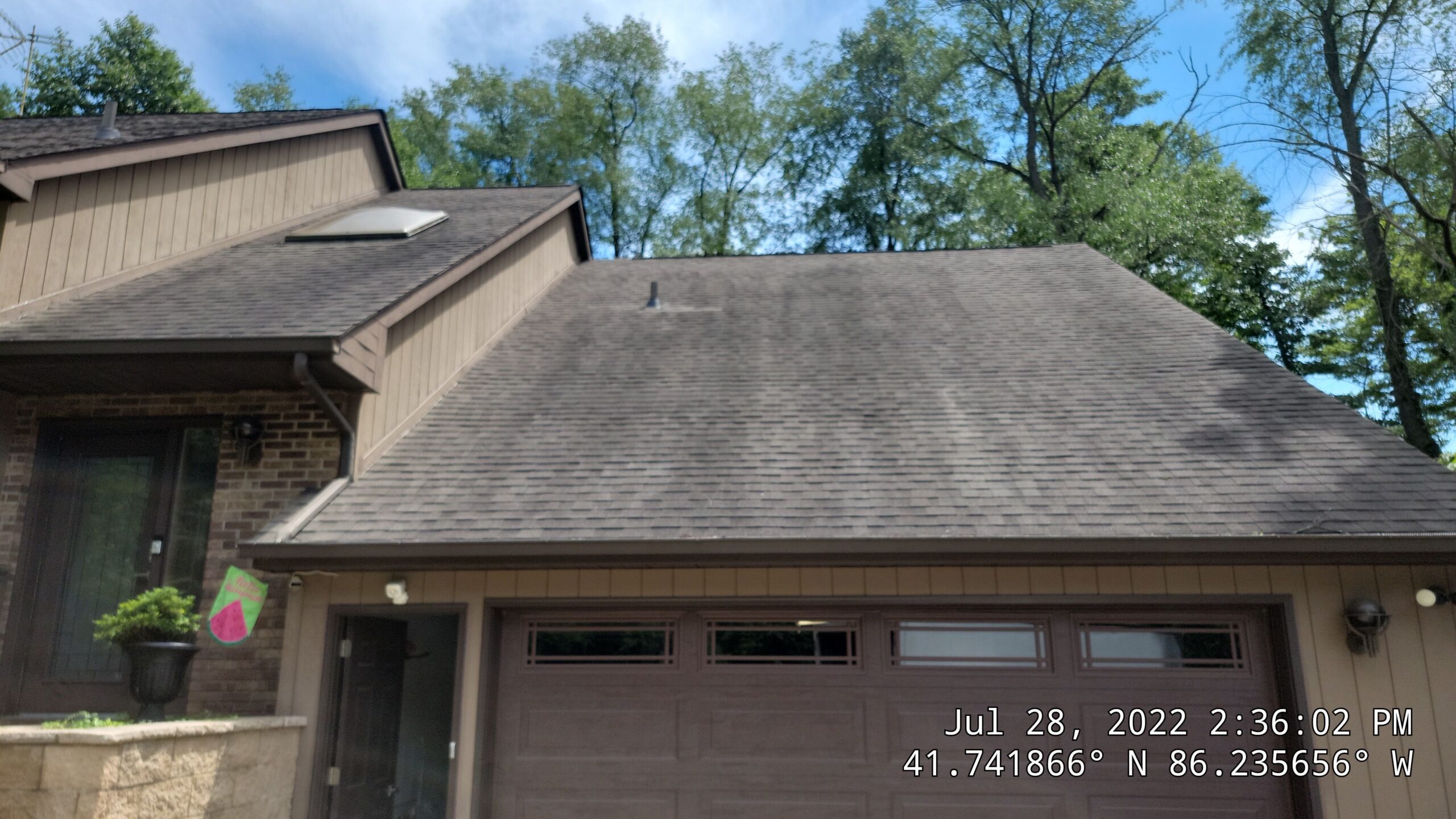
Those dark stripes running down your shingles are not dirt, and they are not your roof showing its age. They are alive.
What you’re looking at is Gloeocapsa magma — a cyanobacteria that colonizes the limestone granules in asphalt shingles and feeds on them slowly, year after year. The black color is a protective pigment the organism produces to shield itself from UV light. It’s not sitting on top of your roof. It’s growing between the granules. And every July in the St. Joseph River valley — with our combination of humidity, warm nights, and mature tree canopy — those colonies expand faster than they would almost anywhere else in the Midwest.
Here’s what makes it worse: pressure washing is probably the single worst response to it. High pressure doesn’t kill the organism. It spreads the spores to every surface the water hits, and it strips granules from your shingles in the process — granules that exist specifically to protect the underlying asphalt from UV degradation. Many shingle manufacturers explicitly warn in their warranty documentation that high-pressure washing can void coverage. So you pay for a wash, the streaks are back within a season, and you’ve quietly shortened the life of a roof that could cost tens of thousands of dollars to replace.
There is a better way. It’s called soft wash roof cleaning, and the difference isn’t just technique — it’s chemistry.
Quick Answer: Black roof streaks are caused by Gloeocapsa magma, a cyanobacteria that lives inside your shingles — soft wash roof cleaning kills it at the source with a low-pressure chemical treatment, while pressure washing just spreads the spores and can void your warranty.
Key Takeaways
- Black roof streaks are Gloeocapsa magma, a living cyanobacteria — not dirt or age.
- Pressure washing spreads the spores, strips granules, and can void your shingle manufacturer’s warranty.
- Soft wash roof cleaning uses a low-pressure chemical mix that kills the organism at the root.
- Results from a proper soft wash typically last two to four years, not two to four months.
- July humidity in Michiana accelerates growth — waiting to treat makes the job harder and the damage deeper.
In This Article
What Soft Wash Roof Cleaning Actually Does
Soft washing is not pressure washing with the dial turned down. It is a fundamentally different process.
We apply a cleaning solution — a calibrated mix of water, surfactant, and sodium hypochlorite — at low pressure, typically under 100 PSI, through a dedicated soft wash system. The surfactant keeps the solution clinging to the sloped surface long enough to work. The sodium hypochlorite penetrates the granule layer and kills the Gloeocapsa magma at the cellular level. Not just the visible stain.
The organism itself. Down to the root.
After the solution dwells on the surface for the appropriate time, we rinse at low pressure. The dead organism washes away. The streaks are gone. And because the biology is dead rather than relocated, regrowth takes years rather than weeks.
Do You Rinse the Roof After Soft Washing?
Yes — and this is one of the questions we hear most often.
After the cleaning solution has done its work, we rinse the roof with low-pressure water. This removes the dead biological matter, any residual chemical, and the black discoloration. No application-and-leave shortcuts here.
The rinse step also protects your landscaping. Sodium hypochlorite in the right concentration is safe for shingles, but it can stress plants if it pools at the root zone. Our crew wets down the surrounding landscaping before we start and rinses everything thoroughly after. We have cleaned hundreds of roofs across St. Joseph and Elkhart counties without landscaping complaints — that’s preparation, not luck.
What we never do is follow the rinse with high pressure. The whole point is letting the chemistry do the work so your shingles never see damaging force.
Pro Tip: Before scheduling a roof cleaning, check whether your shingle manufacturer has a warranty clause about high-pressure washing. Most do. Soft wash is the method most manufacturers recommend for removing biological growth.
Why Michiana’s Summer Weather Makes It Worse
Gloeocapsa magma needs two things to thrive: heat and moisture. The St. Joseph River valley delivers both in abundance from July through August — overnight lows in the high 60s, humidity above 80 percent, sometimes for weeks at a stretch.
Add the mature tree canopy shading older neighborhoods in Mishawaka and South Bend, and you get roof surfaces on the north and west faces that may never fully dry out between rain events. That’s prime growing conditions for a cyanobacteria colony.
If you’re seeing light streaking now and thinking you’ll deal with it next year, the colony will be measurably larger by the time you do. The longer Gloeocapsa magma feeds on the limestone filler in your shingles, the more granule loss accumulates beneath the surface — damage a cleaning cannot reverse.
Ready for a free, no-pressure estimate?
Call or text one of our exterior cleaning specialists, or request your quote online anytime.
Call: 574-221-8400Text: 574-221-8400
Calls & texts answered Mon–Sun, 7AM–7PM
What About Moss and Lichen?
Gloeocapsa magma causes the most common roof staining in our area, but it’s not the only organism we treat. Moss and lichen show up regularly on Michiana roofs, especially on north-facing slopes and under heavy tree coverage.
Moss holds moisture against the shingle surface, accelerating granule loss and eventually working under shingle edges — creating an entry point for water. Lichen is harder to clear because it attaches to the mineral surface with root-like structures called rhizines. Both respond to soft wash treatment, though lichen may need a longer dwell time or a follow-up application.
For most roofs, the soft wash process handles algae, moss, and lichen in a single visit. We assess the surface first and adjust solution concentration and dwell time based on what we’re dealing with.
What Soft Washing Will Not Do
We will always be straight with you: soft washing removes biological growth. It does not repair cracked or missing shingles, fix flashing, or add granules back to a surface that has lost them from years of untreated growth or prior pressure washing. If a roof has physical damage that needs a roofer, we’ll say so. The cleaning is maintenance — not a substitute for structural repairs.
DIY vs. Hiring a Pro
| Factor | DIY / Rental | Double A Power Washing |
|---|---|---|
| Method | Rental pressure washer at 2,000–3,500 PSI | Dedicated soft wash system under 100 PSI |
| What it targets | Removes visible dark staining from the surface | Kills the organism (Gloeocapsa magma) at the cellular level |
| Shingle impact | Strips granules; can void your shingle manufacturer’s warranty | No granule loss; low-pressure method recommended by most shingle manufacturers |
| Spore spread | High-pressure mist carries live spores to adjacent surfaces | Chemistry kills spores; rinse removes dead material |
| Results duration | Visible return of staining within one season | Typically 2–4 years before meaningful regrowth |
| Landscaping protection | No runoff management; chemical pooling risk | Pre-wet and post-rinse protocol protects plants and hardscape |
Pro Tip: Trees overhanging a roof do two things: they keep the surface shaded and damp, and they drop debris that holds moisture against the shingles. Trimming branches back six to ten feet from the roof after a cleaning helps slow the return of algae growth.
How Long Do Results Last?
A proper soft wash roof cleaning — where the organism is killed rather than relocated — typically stays clean for two to four years under normal Michiana conditions. That is the honest range.
Variables include the slope and orientation of the roof, shade from nearby trees, and whether significant granule loss has already occurred. On a well-exposed roof in Granger or South Bend, some customers have gone four-plus years before seeing meaningful staining return. On a heavily shaded north-facing slope with mature oaks overhead, two years is more realistic.
Either way, we’re talking years — not the six to twelve weeks you’d see after a pressure wash that only removed the surface pigment.
Pairing a roof cleaning with our Annual Maintenance Plan is a practical way to stay ahead of it. We schedule the right services at the right intervals so you’re maintaining the asset instead of reacting after the damage is already done.
What to Expect on the Day We Clean Your Roof
Most residential roof cleanings in our service area take two to four hours from the time we pull up.
We start by wetting down your landscaping and any sensitive surfaces at the foundation. Then we apply the soft wash solution from the ground or a ladder — we do not walk the shingles during the cleaning process, which protects both the roof and our crew. After the appropriate dwell time, we rinse thoroughly and do a final walk of the perimeter to check the gutters and confirm runoff is clearing properly.
You do not need to be home. We ask that any gates be unlocked and at least one exterior water spigot is accessible so we can keep the tank topped off during the job.
If your gutters are clogged, this is also a smart time to have them cleaned — debris in the gutters slows roof drainage and contributes to the moisture conditions algae and moss need to grow. We offer gutter cleaning as a standalone service and can often schedule it the same visit.
Looking for more than roof cleaning? We also offer house washing, concrete cleaning, roof cleaning, and gutter cleaning throughout the South Bend area.
Why Choose Double A Power Washing?
Double A Power Washing has been handling roof soft washing across Mishawaka, South Bend, Granger, Elkhart, and into Cass County, Michigan since 2019. We are a locally owned crew — not a franchise, not a call center that dispatches random contractors. When you call (574) 221-8400, you’re talking to the same people who show up at your property.
We’re PWNA certified, BBB A+ accredited, fully licensed and insured with $2 million in general liability coverage, and we carry a 5.0 Google rating across 111 reviews. We use professional-grade soft wash equipment on every roof job — calibrated to the surface we’re treating, every time — because if the chemistry is off, the results won’t last. Our crew has cleaned roofs on everything from 1960s ranch houses in Mishawaka to multimillion-dollar lake homes along the Michigan shoreline. We treat every job the same way: do it right the first time.
What Our Customers Say
“Would highly recommend Double A Power Washing. Aaron did a “soft washing” of our home and pole barn. The results exceeded our expectations. Additionally, Aaron was professional, timely and very responsive.”
— J T, Google Review
Frequently Asked Questions
What causes those black streaks on my roof?
The black streaks are caused by Gloeocapsa magma, a cyanobacteria that feeds on the limestone filler in asphalt shingles. The dark color is a protective pigment the organism produces to shield itself from UV light. It is growing inside the shingle granule layer — not sitting on the surface, and not a sign that your shingles are failing on their own.
Will roof cleaning void my shingle warranty?
Pressure washing can void many shingle warranties — most manufacturers specifically warn against high-pressure cleaning in their warranty documentation. Soft wash roof cleaning, which uses low pressure and a chemical solution to kill biological growth, is the method most manufacturers recommend. We soft wash every roof we treat, which keeps you on the right side of your warranty terms.
How long will the results last after a soft wash?
For most roofs in the South Bend and Mishawaka area, two to four years is a realistic range. Sun exposure, tree coverage, and roof pitch all affect how quickly algae re-establishes. A heavily shaded north-facing slope may need attention closer to the two-year mark; a well-exposed roof in full sun often goes four years or more before staining returns visibly.
Can you clean a roof with moss or lichen, not just algae?
Yes. We treat roofs with moss and lichen regularly across St. Joseph and Elkhart counties. Lichen takes longer to respond because it attaches to the mineral surface with root-like structures, so it may require a longer dwell time or a follow-up application. We assess the surface before we start and adjust the treatment accordingly.
Do you rinse the roof after soft washing?
Yes. After the cleaning solution has had time to kill the biological growth, we rinse at low pressure. The rinse removes the dead material and any residual chemical, and we also rinse the surrounding landscaping to clear runoff. The rinse is part of the standard process — we never apply and leave.
How do I get a roof cleaning estimate in South Bend or Mishawaka?
Call us at (574) 221-8400 or request a free estimate at doubleapowerwashing.com. We’ll gather the details on your roof — size, pitch, type of staining, and any access considerations — and get you a number before we schedule anything. Every estimate is free with no obligation.
Those black streaks are not a cosmetic problem you can ignore until next year. Gloeocapsa magma is feeding on your shingles right now, and Michiana’s summer humidity gives it the best growing conditions it gets all year.
A soft wash roof cleaning from our crew kills the organism, protects your shingle warranty, and gives you years of clean — not another season of watching the dark stripes creep back down your roof.
We serve Mishawaka, South Bend, Granger, Elkhart, and surrounding communities across Indiana and southwest Michigan. Call us at (574) 221-8400 or visit doubleapowerwashing.com to request your free roof cleaning estimate. We will tell you exactly what is on your roof and what it will take to get rid of it.
Keep Reading
North-facing vinyl siding in Granger comes out of every winter coated in green algae and black mildew. Here is why soft washing kills it for…
Is your South Bend home turning green under the humid summer sun? Discover why standard high-pressure washing does more harm than good when …
Black streaks and green slime can quickly take over your home’s exterior during our humid Northern Indiana summers. Learn how our prof…